
How to Preserve Crash Evidence After a Wreck
The minutes after a crash rarely feel clear. Your heart is racing, traffic is moving around you, and someone is already telling you what happened as if their version should become the official one. That is exactly why knowing how to preserve crash evidence matters. Evidence does not wait. Skid marks fade, vehicles get repaired, surveillance footage is erased, and memories shift fast.
If you are hurt, your first job is to get medical help and stay safe. But when you are able, protecting the proof from the very beginning can make the difference between a disputed claim and a claim backed by facts. Insurance companies look for gaps. The other driver may change their story. Strong evidence helps protect your health, your rights, and your ability to recover what this crash has taken from you.
Why preserving crash evidence matters so much
After a collision, the evidence tells the story long before anyone steps into a courtroom. It can show where the impact happened, how hard the crash was, who had the right of way, whether distracted driving may have played a role, and how quickly you sought treatment. Without that proof, the case often becomes a fight over competing statements.
That is especially true when injuries are serious or symptoms worsen over time. A back injury, head injury, or soft tissue injury may not fully show itself at the scene. If the evidence is lost early, the insurance company may argue that your injuries are not connected to the crash at all. Preserving evidence closes off some of those arguments before they start.
How to preserve crash evidence at the scene
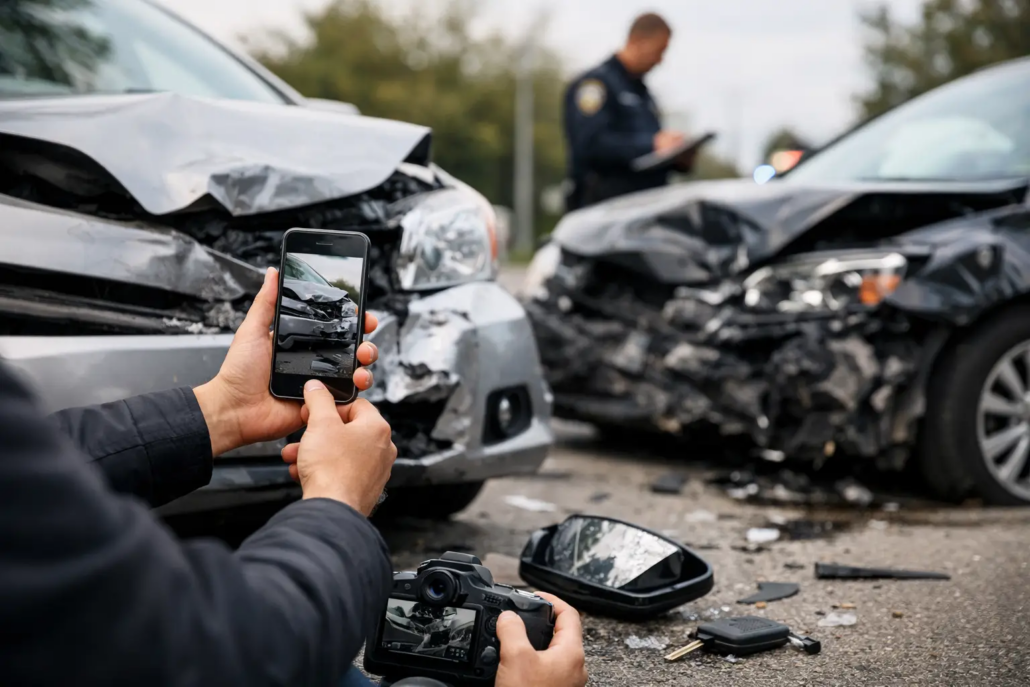
If you can do so safely, start with your phone. Take wide photos and close-ups of every vehicle involved. Capture the full scene, including intersections, lane markings, debris, glass, skid marks, traffic signals, weather conditions, and anything that might help explain how the wreck happened. Do not assume the police or insurers will gather every angle you need.
Take more photos than you think are necessary. Damage can look minor in one image and devastating in another. A broad shot shows vehicle positions. A close-up can show crushed metal, broken lights, deployed airbags, and points of impact. If you have visible injuries, photograph those too, and continue documenting bruising or swelling in the days that follow.
Video can help as well. A short walk-through of the crash scene may capture details that still photos miss, such as traffic flow, sight lines, or obstructions. If someone admits fault or apologizes, do not argue with them, but make a note of what was said as soon as you can.
Get names, witnesses, and official information
Witnesses are often the first evidence to disappear. People leave. Phone numbers get written down wrong. Good Samaritans go back to work and become hard to find later. If anyone saw the crash, ask for their name and contact information. If they are willing, record a short voice memo on your phone describing what they saw, or write down their account while it is fresh.
You should also collect the other driver’s name, contact information, insurance information, driver’s license number, license plate number, and vehicle details. If law enforcement responds, ask how to get the crash report number and the responding officer’s name.
The police report is not the whole case, but it is an important piece of it. It may identify parties, witnesses, roadway conditions, and initial observations that become useful later.
Protect the vehicle before it changes
One of the biggest mistakes people make is letting the car get repaired, salvaged, or destroyed too soon. The vehicle itself is evidence. Its damage pattern, airbag deployment, electronic data, and structural condition can reveal a great deal about the force and mechanics of the crash.
If your vehicle is towed, find out where it is being stored. Do not authorize repairs until the damage has been documented thoroughly and, if necessary, inspected by your attorney or an expert. If the vehicle is totaled, do not assume the insurance company should take possession immediately. In some cases, preserving the vehicle for inspection is critical.
This is one of those areas where it depends on the severity of the crash. In a minor property-damage claim, photos and estimates may be enough. In a major injury or fatal crash, preserving the vehicle can be essential.
Medical records are crash evidence too
When people think about crash evidence, they usually picture damaged cars and broken glass. But your medical timeline is just as important. Go to the doctor as soon as possible after the accident, even if you hope the pain will pass. Delayed treatment gives insurers an opening to say you were not really hurt or that something else caused your condition.
Keep every discharge paper, diagnosis, prescription, referral, imaging result, bill, and receipt. Save records of follow-up appointments, physical therapy, mileage to medical visits, and time missed from work. If your symptoms change, write that down. A simple daily journal can become powerful evidence because it shows how the injury affected your sleep, mobility, pain level, and routine.
You do not need to write like a lawyer. Just be honest and consistent. Real details matter.
Preserve digital evidence before it disappears
Modern crash evidence is often digital, and digital proof can vanish quickly. Nearby businesses, homes, parking garages, or traffic cameras may have recorded the collision. But many systems overwrite footage within days. If you wait too long, it may be gone forever.
That is why early action matters. If you know a store, apartment building, or neighboring property may have captured the wreck, make note of the location immediately. An attorney can then move quickly to request or preserve that footage.
Phone data can matter too. In some cases, call logs, texts, app usage, or GPS information may become relevant. So can rideshare records, delivery logs, vehicle event data, and dash cam footage. Do not delete anything from your phone related to the crash, including photos, texts, or messages with the other driver or insurer.
Be careful what you say and post
Evidence preservation also means not creating problems for yourself. Be careful when speaking to the other driver’s insurance company. They may sound polite and helpful while looking for statements they can use against you. Do not guess about your injuries, speed, or fault. If you do not know something, say so.
The same caution applies to social media. A single post can be twisted out of context. A smiling photo, a vacation picture, or a comment about feeling better can be used to argue that your injuries are exaggerated. Set your accounts to private, but do not rely on privacy settings alone. The safest move is to stop posting about the accident and your physical activity while the claim is pending.
When legal help becomes part of preserving crash evidence
Some evidence is easy to gather on your own. Some is not. Black box data, surveillance footage, business records, roadway maintenance records, and phone records often require immediate and formal action. The longer you wait, the greater the risk that key proof disappears.
That is where a lawyer can do more than file paperwork. A strong legal team can send preservation letters, identify hidden sources of evidence, protect the vehicle from being destroyed, coordinate inspections, and deal with insurers while you focus on healing. For many injured people, that support is not a luxury. It is how the truth stays intact.
Madalon Injury Law understands that after a crash, it is not just a case, it is your life. Protecting evidence early helps protect everything that comes next.
A practical checklist for how to preserve crash evidence
In the first hours and days after a wreck, focus on a few priorities. Photograph the scene and your injuries, get witness and driver information, seek medical care right away, keep your damaged vehicle unchanged if possible, save every record and receipt, and avoid careless statements to insurers or online. If there may be video footage or serious injuries, get legal guidance quickly before evidence disappears.
If you want a general accident resource, see https://accident.usattorneys.com/florida/.
A crash can leave you shaken, angry, and exhausted. You do not need to have every answer in the moment. You just need to protect the truth before someone else tries to rewrite it.