
How Do Signals Shape Miami Motorcycle Intersection Claims?
A motorcycle rider enters an intersection with a green light. At nearly the same moment, a driver begins a left turn and later says the signal had changed—or that the motorcycle was moving too fast to be seen. The rider remembers having the right of way. There may be no neutral witness, and a traffic camera may overwrite its footage before anyone requests it.
That is why a Miami motorcycle intersection accident claim can become a reconstruction problem rather than a simple question of one driver’s word against another. In Miami, changing signal phases, heavy traffic, blocked sightlines, and a motorcycle’s smaller profile can make the evidence difficult to interpret. Riders seeking prompt guidance can review information about Miami motorcycle accident lawyers when conflicting accounts make early evidence preservation important.
Joseph Madalon approaches these cases with attention to the physical story behind the collision. This article explains why intersection crashes are difficult to prove, what evidence may clarify disputed events, and how an injured rider can avoid losing information that may matter later.
Why Is a Miami Motorcycle Intersection Accident Claim So Difficult to Prove?
Intersections compress several decisions into a few seconds. A driver may be turning left, crossing through an opening in traffic, or entering after a signal change while a motorcycle travels straight through. Each person may remember the event differently, especially when the collision or evasive maneuver happens quickly.
The broader Florida intersection crash factors can include right-of-way disputes, turning paths, signal changes, lane markings, and obstructions. A police report can be important, but it may reflect statements available at the scene rather than a complete reconstruction. A citation, standing alone, may not answer every question about timing, visibility, or causation.
Conflicting signals and changing phases
A rider may report entering on a green light while a turning driver recalls having a protected arrow. Both accounts cannot describe the same signal phase at the same moment, but memories can be affected by glare, traffic movement, and the brief sequence of yellow and red indications. Investigators may need to compare signal timing information with travel distances, vehicle positions, and available video.
Signal evidence can include photographs of the signal heads and lane layout, observations from nearby cameras, and records maintained by the responsible transportation agency. The availability and retention period of those materials may vary, so an attorney may advise making preservation requests promptly.
Blocked sightlines and motorcycle visibility
A motorcycle can be hidden by a larger vehicle, a queue of stopped cars, landscaping, construction equipment, or the angle of a turning vehicle. That does not by itself establish fault, but it can explain why a driver claims not to have seen the rider. Investigators may examine where each person was positioned, what could be seen from the driver’s seat, and whether the motorcycle’s lights or movement should have been visible.
What Evidence Can Clarify a Motorcycle Crash at a Miami Intersection?
When stories conflict, the goal is to preserve independent evidence before it disappears or conditions change. Depending on the circumstances, useful evidence may include:
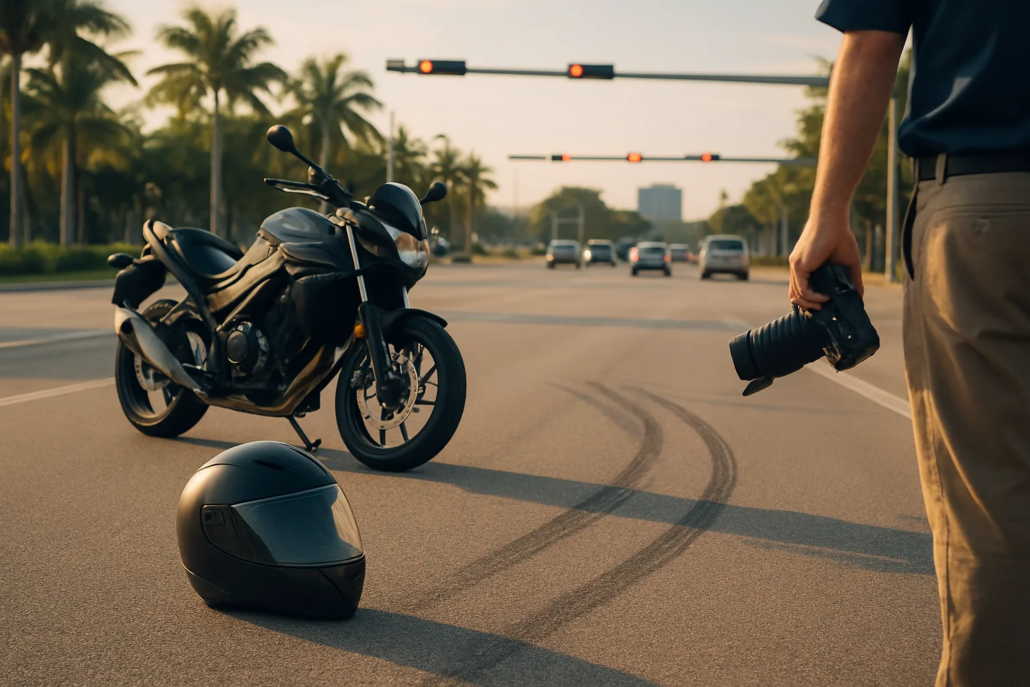
- Scene photographs: Images can show signal heads, lane arrows, stop lines, traffic-control devices, sight obstructions, skid marks, debris, road defects, and the final positions of vehicles. Photographs should be taken only when it is safe and lawful to do so.
- Witness information: Names and contact details are valuable, along with a short note about where each witness stood or drove. A witness who saw the signal may have a different perspective from one who saw only the impact.
- Dashcam and business video: Nearby vehicles, gas stations, residences, and businesses may have cameras. Footage can be overwritten automatically, so a preservation request may be time-sensitive.
- Signal-phase evidence: The relevant agency may maintain information about signal operation or timing. An attorney or reconstruction professional may assess whether those records can be obtained and compared with the accounts.
- Vehicle damage and debris: Scrapes, crush patterns, broken parts, paint transfer, and debris distribution may help identify the direction and angle of movement. The motorcycle and other vehicles should generally be preserved before repairs or disposal when possible.
- Electronic and phone evidence: Some vehicles or cameras may contain time-stamped data. Images and recordings should be kept in their original form, with copies made for review rather than editing the only version.
The details matter in a left turn motorcycle accident in Florida. Damage near a motorcycle’s front, side, or rear may support different movement theories, but damage alone does not prove which driver was legally responsible. A qualified reconstruction professional may need to compare the physical evidence with statements, measurements, and available video.
What Should Miami Riders Do When Drivers Tell Different Stories?
An injured rider may feel pressure to explain the crash immediately, especially when the other driver gives a confident version of events. General steps that may help preserve the factual record include:
- Get medical attention and follow professional instructions. Medical decisions belong with healthcare professionals. Records can also document complaints and the timing of care.
- Preserve photographs and recordings. Keep original scene images, helmet-camera files, dashcam clips, and messages. Do not rely only on social-media uploads or compressed copies.
- Write down the sequence while memory is fresh. Note the lane, direction of travel, signal appearance, traffic conditions, weather, nearby vehicles, and any evasive movement. This is a factual record, not a substitute for investigation.
- Identify possible cameras and witnesses. A nearby business may not know which camera covers the intersection, and footage retention practices differ. Prompt notice may help preserve potentially relevant material.
- Avoid guessing about speed, signal timing, or fault. A rider can accurately describe what was observed without adopting an uncertain conclusion.
Some crashes involve no direct motorcycle impact. A rider may brake or swerve to avoid a turning vehicle and fall several feet away. In that situation, proving fault when the vehicles never touch may require skid marks, the rider’s path, debris, damage to nearby property, witness accounts, and video that connects the maneuver to the crash.
Motorcycle-specific context also matters. Florida motorcycle lane-position evidence can help explain why lane position, stopped traffic, blind spots, and what a driver could see should be examined carefully rather than reduced to a conclusion based only on a citation or assumption.
A rider may also need to separate two issues: proving how the crash occurred and identifying available insurance. If the driver is uninsured, underinsured, or unidentified, Miami motorcycle uninsured motorist coverage may become relevant depending on the policy language and circumstances. Insurance questions can involve deadlines, notice provisions, and recorded statements, so an attorney may advise reviewing the policy before making important decisions.
Frequently Asked Questions
Can a rider prove a Miami motorcycle intersection claim without video?
Yes, video is helpful but not always required. Photographs, signal records, witness accounts, vehicle damage, debris patterns, skid marks, medical records, and the parties’ statements may collectively establish a timeline. The strength of the evidence depends on its reliability and how well the pieces fit together. A reconstruction professional may be useful when the available proof is technical or contradictory.
What if the other driver says the motorcycle ran a red light?
A driver’s statement is evidence, but it is not automatically conclusive. The investigation may compare the statement with signal timing, traffic-camera footage, witness observations, vehicle positions, lane markings, and physical damage. A rider should avoid guessing or arguing at the scene. In Miami, the available evidence and applicable Florida law will depend on the specific facts and may change over time.
Can an intersection crash be reconstructed if the motorcycle was damaged after the collision?
Possibly. Photographs taken before repairs, repair estimates, inspection records, parts retained by a repair facility, and testimony about the damage may still provide useful information. However, later changes can make analysis more difficult. Preserving the motorcycle, helmet, riding gear, and other relevant items may help an attorney or qualified expert evaluate the evidence.
Why do witness accounts differ after a motorcycle crash?
Witnesses may view the intersection from different angles and may focus on different moments, such as a signal, a turn, or the impact. Traffic noise, glare, obstructed views, and the speed of events can also affect recollection. Differences do not automatically mean a witness is unreliable, but investigators should compare each account with objective evidence and the witness’s position.
How Joseph Madalon Can Help
Joseph Madalon is dedicated to helping injured riders understand the evidence and legal issues that may affect a personal injury claim. The firm can evaluate whether photographs, witness information, signal-phase evidence, vehicle damage, video, and reconstruction questions require further attention. That review may also help identify unanswered questions about insurance coverage and disputed responsibility. For additional context on this issue, see How to Preserve Accident Evidence After a Crash.
For riders in Miami, FL, prompt organization of evidence can be important because temporary footage may disappear and physical conditions can change. If you were injured in an intersection crash, contact Joseph Madalon for a free consultation or case evaluation. The firm is committed to fighting for your rights while helping you explore your legal options.
The information in this article is for educational purposes only and does not constitute legal advice. Contact a qualified attorney licensed in Miami, FL for advice specific to your situation.






Leave a Reply
Want to join the discussion?Feel free to contribute!