
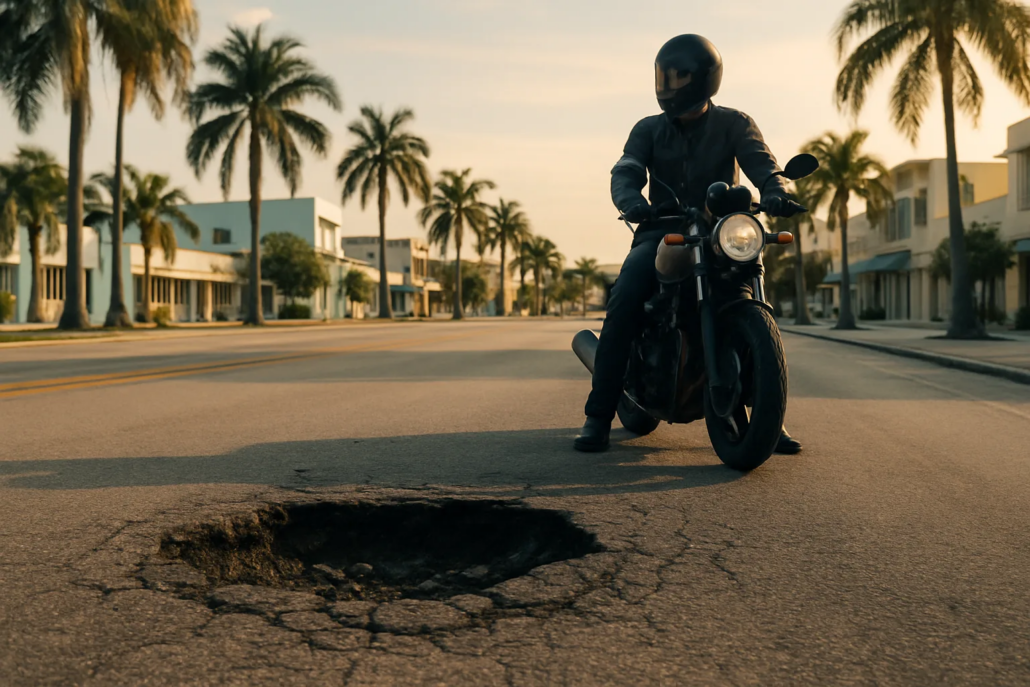
What Evidence Supports a Miami Motorcycle Pothole Case?
A pothole can look like an ordinary road nuisance until a motorcycle tire drops into it, the rider loses control, and the resulting injuries require medical care. For someone considering a Miami motorcycle accident pothole claim, the central question is often not simply who was riding, but who owned, controlled, inspected, designed, repaired, or had notice of the dangerous condition.
A single-bike crash does not automatically mean the rider caused the collision. Joseph Madalon helps injured people understand how roadway conditions, maintenance records, warnings, and other facts may affect a personal injury claim. This guide explains who may be liable, how to document the defect and injuries, how to identify the road owner, and why claims involving public entities can involve special procedures in Florida.
Who May Be Liable in a Miami Motorcycle Accident Pothole Claim?
Liability depends on the facts and the entity responsible for the location. A roadway defect may involve more than one potentially responsible party, and responsibility is not established merely because a crash occurred near a pothole. Investigators generally examine whether the condition was unreasonably dangerous, whether the responsible party knew or should have known about it, and whether reasonable inspection, repair, or warning practices were followed.
Possible responsible entities
Depending on the road and defect, a claim may involve:
- The City of Miami or another municipality responsible for a local street.
- Miami-Dade County, if the county owns or maintains the roadway.
- The Florida Department of Transportation, for certain state roads or transportation facilities.
- A construction or maintenance contractor whose work created or failed to correct a hazard.
- A private property owner or manager controlling a driveway, parking area, or privately maintained access road.
- Another driver or vehicle owner, if a separate collision or evasive maneuver contributed to the crash.
A dangerous condition may include more than a pothole. Missing warnings, poor lighting, uneven pavement, drainage problems, construction debris, or a defective roadway design can also matter. The principles discussed in Florida defective roadway claims include the importance of notice, maintenance duties, and reasonable inspection practices.
How Can Riders Prove the Defect and Identify the Road Owner?
Road conditions can change quickly. A pothole may be filled, resurfaced, widened, or repaired before a claim is fully investigated. Prompt, safe documentation can help preserve information about what existed at the time of the crash. Do not enter traffic or put yourself at risk to obtain a photograph. For additional context on this issue, see How to Preserve Accident Evidence After a Crash.
Useful evidence may include:
- Photographs or video of the pothole from multiple distances and angles, showing its position in the lane and nearby landmarks.
- The exact location, direction of travel, lane position, weather, lighting, and approximate time of the crash.
- Photographs of the motorcycle, helmet, clothing, and other damaged equipment.
- Names and contact information for witnesses, nearby businesses, and responding officers when available.
- Dash-camera, helmet-camera, security-camera, or smartphone footage in its original form.
- Roadwork signs, cones, barriers, repair markings, or the absence of warnings.
The single-motorcycle crashes caused by roadway hazards resource explains why a solo crash still requires a careful review of surface conditions, visibility, speed, warnings, and riding circumstances. A rider’s account should be preserved promptly, while memories are fresh.
To identify the road owner, a lawyer or investigator may review roadway signs, public mapping information, maintenance boundaries, property records, permit information, and agency reports. In Miami, FL, the responsible entity may differ from one block to the next. A road may be maintained by the City of Miami, Miami-Dade County, FDOT, a private development, or a contractor working under an agreement.
What Procedures and Evidence Matter After a Roadway-Defect Crash?
Evidence about the roadway is only part of a claim. The injured rider also needs a clear record of the harm and the expenses connected to it. Prompt medical evaluation can help document symptoms and injuries, although only a medical professional can assess a person’s condition. Photographs of visible injuries, medical records, treatment instructions, and notes about symptoms or work restrictions may be relevant. Guidance on documenting motorcycle crash injuries covers ways to organize this information.
A rider should also be cautious about making assumptions before the facts are reviewed. Common sources of dispute include:
- Whether the pothole existed before the crash and was large or dangerous enough to create a foreseeable risk.
- Whether the road owner had actual or constructive notice of the condition.
- Whether a contractor had responsibility for repair, construction, or traffic control.
- Whether speed, visibility, weather, a mechanical issue, or another vehicle contributed.
- Whether the rider’s conduct affects comparative responsibility under Florida law.
Claims involving a public entity can require additional care. Government liability for a motorcycle accident in Florida may involve specific pre-suit notices, procedural steps, damage limitations, and deadlines that differ from an ordinary claim. The exact requirements can depend on the entity and facts, and laws may change. Readers should verify current rules rather than relying on a general checklist about Florida government-claim deadlines and filing requirements. A closer look at this related topic is available in Car Accident Liability.
Payment of medical expenses may also require separate analysis. Florida PIP coverage does not automatically resolve every motorcycle crash bill, so riders may need to examine health insurance, medical-payment coverage, available liability insurance, and other possible sources. See the discussion of Florida PIP coverage for motorcycle crash bills for background.
Frequently Asked Questions
Can a rider bring a claim if no other vehicle was involved?
Possibly. A single-bike crash may support a claim if a dangerous pothole, roadway design, missing warning, construction condition, or other hazard contributed and a responsible party had a legal duty related to the area. The facts still matter, including visibility, speed, weather, vehicle condition, and the rider’s actions. A solo crash is not automatically proof of roadway liability or rider fault.
How can I show that a city or county knew about the pothole?
Notice may be shown through prior complaints, inspection records, work orders, repair histories, photographs, witness accounts, or evidence that the condition existed long enough that reasonable inspections should have discovered it. The available evidence depends on the roadway and responsible entity. A public-records request or formal investigation may be useful, but applicable procedures and timing should be reviewed for the specific claim.
Should I report the pothole after a Miami motorcycle crash?
Reporting the condition to the appropriate road owner may create a record, but a report does not by itself establish liability. Riders should prioritize safety and medical attention, preserve photographs and other evidence, and avoid returning to traffic to document a hazard. The correct agency may be the City of Miami, Miami-Dade County, FDOT, or a private property manager, depending on the location.
What if the pothole was repaired before I photographed it?
A repaired pothole does not necessarily end an inquiry. Other evidence may include photographs taken by witnesses, crash-scene images, video, repair records, maintenance logs, prior complaints, expert analysis, and testimony about the condition. Promptly identifying the location and preserving original files can help. An attorney may also assess whether records or other sources could document the roadway’s prior condition.
How Joseph Madalon Can Help
Joseph Madalon is dedicated to helping injured riders evaluate the facts behind a roadway-defect crash. A review may include the crash location, photographs, medical records, witness information, insurance coverage, roadway ownership, maintenance responsibilities, and whether a contractor or public entity may be involved.
Because potholes can be repaired and evidence can disappear, early review may be valuable. The firm is committed to fighting for clients’ rights while explaining potential claims and limitations in clear terms. If you are seeking Miami motorcycle accident legal guidance, contact Joseph Madalon for a free consultation or case evaluation.
The information in this article is for educational purposes only and does not constitute legal advice. Contact a qualified attorney licensed in Miami, FL for advice specific to your situation.






Leave a Reply
Want to join the discussion?Feel free to contribute!