
What Evidence Proves Fault in Miami Motorcycle Left Turns?
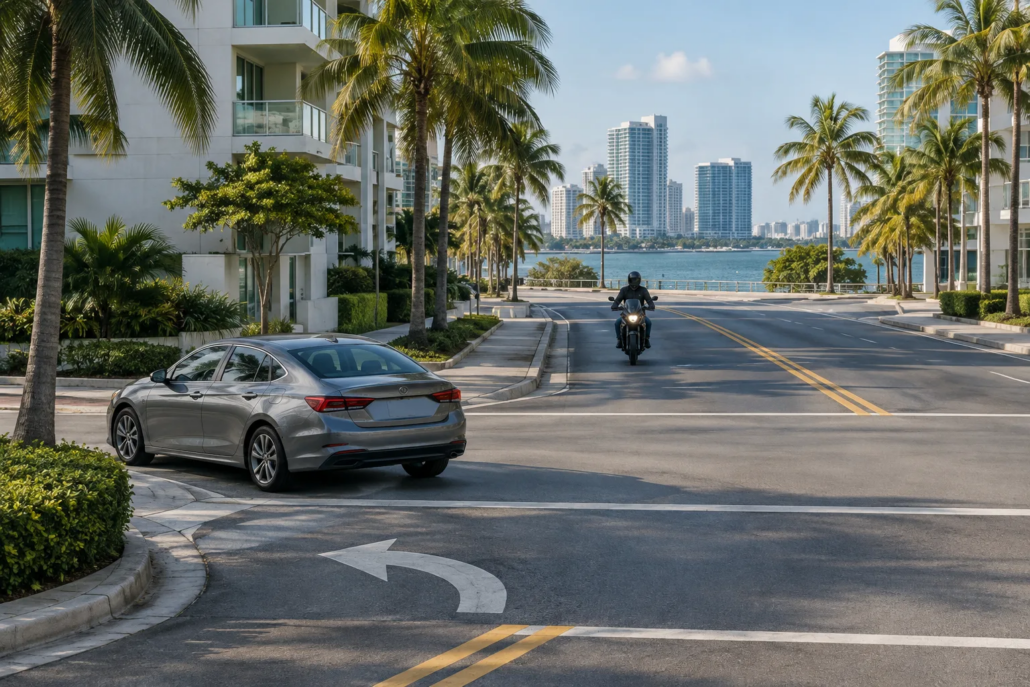
A driver begins a left turn across an intersection just as a motorcycle approaches. The rider brakes or swerves, and the vehicles collide—or narrowly miss each other. In the moments afterward, each person may remember the signal, speed and distance differently. For someone searching for a Miami motorcycle left turn accident lawyer, the central question is often what evidence can clarify the sequence without assuming either person was automatically at fault.
In Miami, traffic patterns, multiple turn lanes, glare and busy intersections can make the details especially important. Joseph Madalon can help riders and families understand what kinds of evidence may matter and how an investigation can examine timing, visibility and movement. This guide covers signal records, cameras, vehicle damage, witness accounts, photographs of sightlines and other evidence that may help explain a left-turn collision.
What Evidence Can Clarify Fault in a Miami Motorcycle Left-Turn Crash?
A useful investigation tests the accounts against evidence from several sources. The fact that one vehicle was turning does not, by itself, answer whether the driver had a clear view, how the motorcycle was moving or what the traffic signal allowed. Likewise, a rider’s presence in an intersection does not settle every question about speed, visibility or reaction time.
Signals, timing and intersection cameras
The signal phase can help establish whether a vehicle had a green light, a protected turn arrow or a signal that was changing. Depending on the intersection and the agency responsible for it, timing information or video may be available from transportation agencies, nearby businesses, residences or traffic systems. Footage may be overwritten, and not every intersection has a camera that records usable video, so availability and retention can vary.
A signal’s color alone may not show exactly when a vehicle entered the intersection. Timing records, footage and witness accounts may add context. For a closer look at this issue, see how traffic-signal evidence shapes Miami motorcycle intersection claims.
Damage, debris and vehicle data
The location and direction of damage on a car and motorcycle can help investigators assess the angle and point of impact. Scrapes, broken parts, debris and marks on the roadway may also help reconstruct movement. But damage does not establish fault on its own: it must be interpreted alongside scene measurements, photographs and reliable accounts. Some vehicles may record event or system data, though access, availability and meaning depend on the vehicle and circumstances.
How Can Witnesses, Photographs and Records Fill in the Gaps?
Physical evidence is only part of the picture. A witness may have seen the car begin turning, noticed the motorcycle’s position, or observed a signal change. Investigators may ask where each witness was standing or traveling, what blocked the view and how soon after the collision the witness shared their account. A person’s vantage point can matter as much as the fact that they saw something.
Photographs are most useful when they document the scene from relevant viewpoints. Images taken from the driver’s approach and the rider’s approach can show parked vehicles, landscaping, signs, lane markings, curves or other possible sightline obstructions. Wider views provide context; closer images can preserve details such as skid marks, debris and vehicle damage. In Miami-Dade County, photographs of the intersection may also help explain how nearby lanes and turn paths relate to one another.
The conditions should be recorded as accurately as possible. Lighting, weather, road work and traffic can change, so a later photograph may not perfectly match the crash scene. For nighttime collisions, evidence that can clarify visibility in a nighttime motorcycle crash may help readers understand why lighting and glare deserve close attention.
If a rider swerves and the vehicles do not touch, evidence can still help document the sequence. Witness accounts, the rider’s route, photographs and physical marks may connect an evasive maneuver to the other vehicle’s movement, though causation may be disputed. See more about evidence in a Miami motorcycle crash without vehicle contact.
What Investigation Steps and Common Mistakes Matter?
A careful review considers evidence together rather than treating one document or recollection as decisive. A police crash report can record observations and statements, but it is not necessarily a final decision about civil fault. In Miami-Dade, the responding law enforcement agency and other relevant sources may hold records or information, while signal or camera materials may be maintained by a different public or private entity.
Common evidence problems include:
- Waiting too long to ask whether nearby cameras captured the intersection, because some systems retain footage only temporarily.
- Relying on memory alone instead of recording witness names and contact details, if available.
- Taking only close-up photographs that do not show the intersection layout or the approach to the turn.
- Assuming vehicle damage, a traffic citation or a crash report conclusively decides responsibility.
- Making unsupported assumptions about distraction rather than looking for evidence that could confirm or rule it out.
When circumstances raise a genuine question about phone use or another distraction, relevant records or other evidence may help explain the driver’s actions. The scope of available evidence and access to it can depend on the facts and applicable law. A related discussion of evidence that may help show driver distraction before a motorcycle crash explains why distraction should be investigated when supported by circumstances, not presumed.
Florida rules on negligence and shared responsibility may affect how fault is allocated in a claim. The applicable rules can depend on the claim and may change; laws also vary by location. A lawyer reviewing a Miami car and motorcycle accident claim can assess how the evidence and current Florida law apply to the specific circumstances.
Frequently Asked Questions
Does a driver automatically have fault when turning left in front of a motorcycle?
No. The turning movement is an important fact, but it does not automatically resolve fault. The signal, positions and movement of both vehicles, visibility, timing and each person’s actions may all matter. Evidence can support or challenge different accounts. In Florida, responsibility may be evaluated under applicable negligence rules, so a complete review is more informative than drawing a conclusion from the type of collision alone.
Can traffic-camera footage prove who had the right of way?
Footage may show vehicle movements, signal indications or when a vehicle entered the intersection, but it may not capture every relevant detail. Camera angle, image quality, recording duration and signal visibility all affect what it can establish. Some cameras do not record, and some footage may not remain available for long. Signal timing information and witness accounts may help provide context when video is incomplete.
What if no one witnessed the crash?
A lack of independent witnesses does not necessarily mean there is no evidence to review. Scene and vehicle photographs, roadway marks, debris, available video, signal information and statements made close to the event may help clarify the sequence. The value of each item depends on its reliability and context. A lawyer can evaluate what sources may exist in a particular Miami crash and whether they can be obtained.
Should I preserve photographs and witness information after a Miami crash?
Photographs and witness details can be useful because road conditions, debris and people’s availability may change. If it is safe and practical, documenting the scene and noting how to contact witnesses can help preserve information. Avoid putting yourself in danger to collect evidence. The right next steps depend on your circumstances, and an attorney licensed in Florida can explain options specific to your situation.
How Joseph Madalon Can Help
A left-turn motorcycle collision can raise disputed questions about what each person could see, when the turn began and how the vehicles moved. Joseph Madalon is dedicated to helping injured riders and families understand the evidence that may be relevant to a Miami claim. A review may consider available camera footage, signal information, witness accounts, scene photographs, vehicle damage and other records, while keeping in mind that no single item necessarily decides fault. The firm is committed to fighting for clients’ rights and is ready to evaluate your situation. Contact Joseph Madalon for a free consultation or case evaluation to discuss your options.
The information in this article is for educational purposes only and does not constitute legal advice. Contact a qualified attorney authorized to practice in the jurisdiction that applies to your matter for advice specific to your situation.






Leave a Reply
Want to join the discussion?Feel free to contribute!