
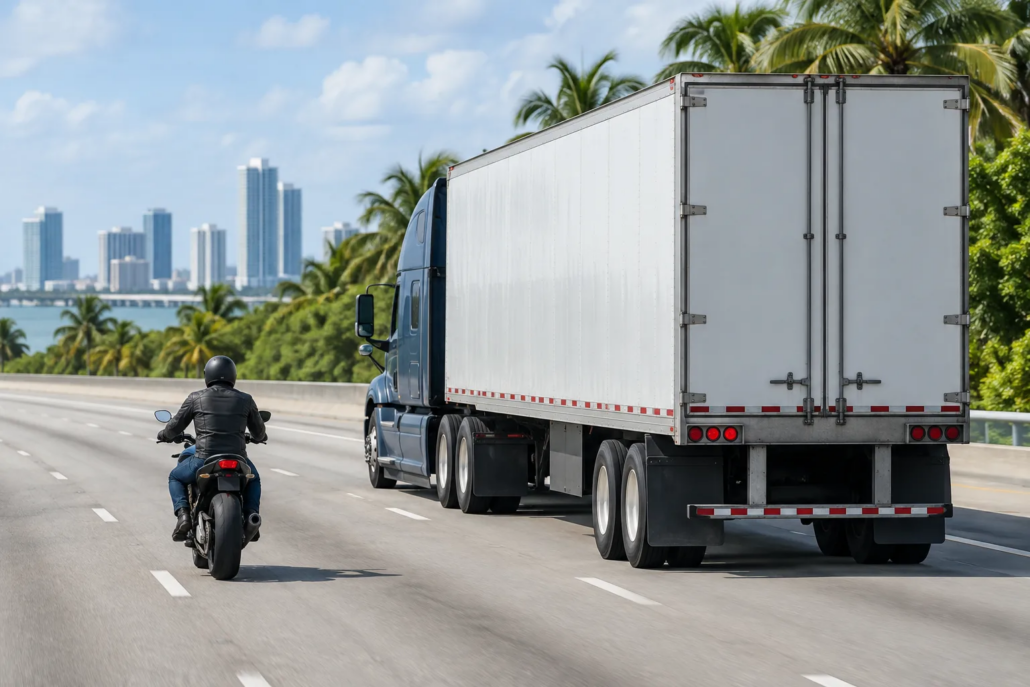
Why Are Miami Motorcycle Blind-Spot Crashes Hard to Prove?
A motorcycle may be visible beside a truck one moment and hidden by its cab or trailer the next. After a collision, the rider and truck driver may describe different positions and movements, while traffic, weather, and vehicle damage complicate the picture. For anyone looking for a Miami motorcycle truck accident lawyer, understanding how investigators piece together those details can help make the process less opaque. Joseph Madalon can help explain the kinds of evidence that may matter in a claim, without assuming what happened before the facts are reviewed.
This guide covers why truck blind spots are only part of the issue, what to record about the company, vehicles, rider’s position, witnesses, and cameras, and how vehicle data or roadway records may help establish a timeline. In Miami, where a crash may involve busy multilane roads or an intersection turn, small details about direction and spacing can become important. Evidence can be difficult to recover later, so knowing what may exist is useful.
Why motorcycle crashes in a truck’s blind spot are hard to investigate
A truck’s mirrors provide views around the vehicle, but they do not necessarily show every area beside or behind it. The cab, trailer, mirror setup, and the angle between the two vehicles can affect what is visible. A motorcycle is also narrower than a passenger vehicle, and its position changes quickly as traffic moves. A rider may be in a truck driver’s view at one point and obscured moments later.
That makes a simple question—whether the driver could see the motorcycle—dependent on time, place, and movement. Investigators may need to distinguish a truck lane change from a motorcycle entering a lane, or determine whether a truck’s turn swept across the rider’s path. Damage locations and final resting positions can provide clues, but they do not always establish the full sequence by themselves. Competing accounts make careful evidence collection central to building a Miami motorcycle-truck accident claim.
Reconstructing the truck’s path
The truck’s turning arc, lane position, signal use, and speed of movement may matter alongside the motorcycle’s path. At an intersection, a wide turn can change the space available to a rider; on a multilane road, a trailer may follow a different line from the cab. Signal timing and road markings may help clarify the sequence. For more context on intersection evidence, see how traffic signals and turning movements shape Miami motorcycle claims.
What evidence can clarify a Miami truck blind-spot crash?
A useful investigation may bring together several kinds of evidence rather than rely on one account. If it is safe to do so, scene documentation may capture details that change when vehicles are moved or traffic clears. A rider or witness might record:
- The trucking company or carrier name, truck and trailer numbers, license plate, and any visible USDOT number.
- The motorcycle’s apparent lane, direction, position, and distance from the truck, plus lane markings, traffic signals, and nearby vehicles.
- The truck’s direction of travel and whether it appeared to be turning, merging, or changing lanes.
- Names and contact details for willing witnesses, and the locations of visible dashcams, business cameras, or roadway cameras.
Avoid entering traffic or approaching an unsafe vehicle to gather details. A truck accident evidence checklist can help organize these observations. The carrier’s identity and whether the driver was working may also be relevant to determining which parties and insurance policies warrant review; learn more about employer liability and commercial insurance after a Miami motorcycle crash.
Camera footage and vehicle data
Commercial vehicles may have onboard cameras, event data recorders, GPS, or telematics, but equipment varies by vehicle and operator. These sources may help establish movement, braking, or timing, depending on what was installed, recorded, and retained. Nearby businesses, transit vehicles, and private cars may also have footage. Availability is not guaranteed, and recordings may be overwritten or otherwise become unavailable, so an investigation may need to identify potential sources promptly.
In Miami-Dade, the agency that responded—such as the Florida Highway Patrol or Miami-Dade Police Department, depending on the location and circumstances—may have a crash report or other records. Roadway camera footage, when available, may be held by a different agency or operator. The record source and retention process vary, so do not assume every camera captured the crash or that footage will remain available.
How to document rider position, disputed fault, and no-contact crashes
The rider’s position is often a central point of disagreement. Evidence of lane markings, vehicle spacing, road layout, and the motorcycle’s path may help test each account. A photograph taken after the vehicles have moved may not show where they were at impact, so scene images, witness observations, and any available video can provide useful context. An allegation about lane position, including lane splitting, calls for a fact-specific review; it should not be assumed from the fact that a crash involved a motorcycle. This overview explains what may count as evidence about a motorcycle’s lane position in Florida.
Not every serious motorcycle crash involves direct contact. A rider may brake, swerve, or fall while avoiding a truck that appears to enter the motorcycle’s path. The absence of contact can make proof more challenging, but it does not by itself answer whether a truck’s movement contributed. Witness accounts, roadway marks, scene photographs, vehicle damage, and a consistent timeline may help document what happened. See more about proving fault when a Miami motorcycle crash happens without contact.
Florida’s fault rules and evidence procedures may affect how a claim is evaluated, and they can change. A crash report is a source of information, not necessarily a final decision about civil liability. In Miami, the responding agency, road owner, and camera operator may each hold different records. An attorney can assess what sources may be relevant and how disputed evidence fits together; the right approach depends on the circumstances.
Frequently Asked Questions
Can a truck driver’s blind spot prove who caused a motorcycle crash?
Not by itself. Blind spots explain why visibility may be disputed, but an investigation also considers the truck’s movement, the motorcycle’s location, signals, road layout, and available accounts or recordings. Evidence may support different interpretations, and fault depends on the facts and applicable Florida law. A lawyer can review the available information without treating the presence of a blind spot as automatic proof of responsibility.
What truck details should be recorded after a Miami crash?
When it is safe, useful identifying details may include the carrier’s name, truck and trailer numbers, license plate, and visible USDOT number. A photo can preserve how those identifiers appeared at the scene, but no one should enter traffic or approach a hazardous vehicle to obtain them. The carrier identity may help identify who operated the truck and whether a work-related trip is relevant to the investigation.
Can a motorcycle claim involve a truck if there was no collision between them?
It may, depending on the evidence and applicable law. A rider could fall or take evasive action in response to a truck’s movement without the vehicles touching. Witness statements, video, roadway marks, and evidence of each vehicle’s path may help explain the event. Whether the truck’s conduct legally contributed to the crash is a fact-specific question, not something that can be determined from no-contact status alone.
Could a truck’s camera or electronic data help explain the crash?
Potentially. Depending on the truck’s equipment and what was recorded and retained, onboard video, event data, GPS, or telematics may help clarify timing or vehicle movement. Other possible sources include nearby business or vehicle cameras. Not every truck or location has usable footage, and retention practices differ. An attorney can help evaluate which sources may exist and whether they are relevant to the disputed facts.
How Joseph Madalon Can Help
Joseph Madalon is dedicated to helping people understand the evidence and legal questions that may arise after a motorcycle and commercial truck collision. A review may consider the truck’s company and vehicle identifiers, the rider’s position, the truck’s path, witness accounts, possible video, and available vehicle data. The facts of each crash are different, and no particular result can be promised. If you are dealing with a truck-related motorcycle crash in Miami, contact Joseph Madalon’s office to ask about a free consultation or case evaluation and discuss your situation.
The information in this article is for educational purposes only and does not constitute legal advice. Contact a qualified attorney authorized to practice in the jurisdiction that applies to your matter for advice specific to your situation.








Leave a Reply
Want to join the discussion?Feel free to contribute!