
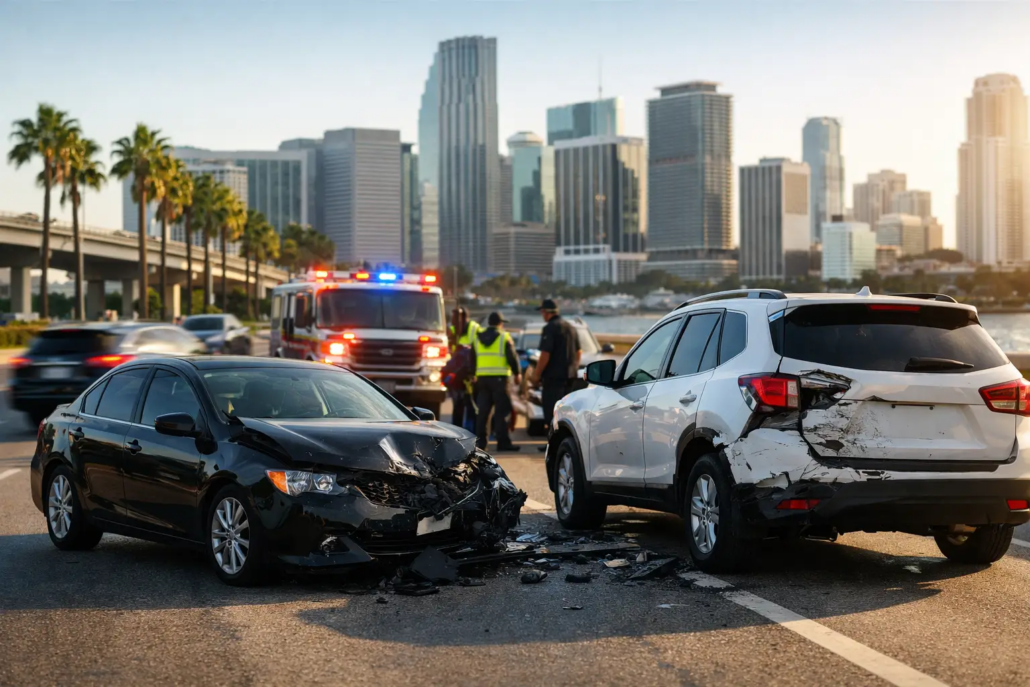
Miami Traffic Accident Trends in 2025
A crash on I-95 at rush hour is not just a traffic delay. It is a missed shift, a child waiting to be picked up, an ambulance ride, a wrecked car, and a family suddenly thrown into stress. That is why miami traffic accident trends matter. They are not abstract numbers. They show where people are getting hurt, why certain crashes keep happening, and how quickly a normal day can turn into a legal and financial fight.
What Miami traffic accident trends are really showing
The big picture is simple: Miami remains a high-risk driving environment because of density, speed, tourism, aggressive driving, distracted driving, and a road network that mixes local commuters with visitors, delivery drivers, rideshare vehicles, motorcycles, buses, and freight traffic. When all of that meets heavy rain, late-night traffic, and constant construction, the result is predictable. Crashes do not happen randomly. They cluster around pressure points.
Some of those pressure points are obvious. Major highways, busy intersections, and entertainment districts see more collisions because they carry more vehicles. But volume alone does not explain everything. The more troubling trend is the mix of behaviors involved – speeding through yellow lights, following too closely, drifting between lanes, checking a phone in moving traffic, and driving while impaired or fatigued.
For injured people, that matters because the cause of a crash often shapes the insurance battle that follows. A rear-end collision may look straightforward until the insurer argues that your injuries were minor or preexisting. A T-bone crash at an intersection may involve a dispute over who had the light. A multi-car pileup may leave several drivers pointing fingers while you are left trying to get medical care.
Where Miami traffic accident trends hit hardest
Certain areas naturally produce more serious wrecks. High-speed corridors like I-95, the Dolphin Expressway, and other major arteries create a greater chance of catastrophic injuries because force increases with speed. On local roads, the danger often shifts from pure speed to conflict points – left turns, pedestrian crossings, sudden stops, and unclear merging patterns.
Miami Beach and entertainment-heavy areas often bring another variable into play: unfamiliar drivers. Visitors may rely heavily on navigation apps, make last-second lane changes, stop abruptly, or miss traffic patterns that locals expect. That does not excuse negligence, but it does help explain why congestion plus confusion can become a dangerous mix.
Urban intersections remain a major concern. Many severe crashes happen where one bad choice collides with another – a driver rushing to beat the light and another assuming the intersection is clear. These are the cases where injuries can be life-changing, especially when a side-impact crash crushes the occupant space of a smaller vehicle.
The most common crash patterns behind the numbers
If you strip away the statistics, recurring crash types tell the real story.
Rear-end collisions remain common because Miami traffic often moves in bursts. One lane speeds up, another stops, and a distracted driver loses the few seconds needed to react. These wrecks are often brushed off as minor, but neck, back, and head injuries can linger for months.
Side-impact crashes are especially dangerous at intersections. They tend to happen when drivers run red lights, misjudge turns, or fail to yield. The trade-off is that modern vehicles may offer some side-impact protection, but the human body still absorbs violent lateral force in a way that can lead to fractures, internal injuries, and traumatic brain injuries.
Lane-change and merge collisions are also a persistent issue. With crowded roads, drivers often force their way into small gaps or fail to check blind spots. This is even more dangerous around motorcycles, which are easier to miss and far less protected in any impact.
Pedestrian and bicycle crashes deserve special attention. In dense areas, a person on foot or on a bike has almost no margin for error when a driver is distracted or speeding. Even a collision at moderate speed can cause devastating harm.
Why serious injuries remain a major concern
One of the hardest truths behind miami traffic accident trends is that not every crash looks severe at first. Some injuries do not fully show themselves at the scene. Adrenaline masks pain. Symptoms appear hours later. What felt like soreness becomes a diagnosed disc injury, concussion, torn ligament, or chronic pain condition.
That delay creates an opening for insurance companies. If you wait too long to seek treatment, they may argue that you were not badly hurt or that something else caused your condition. This is one reason early medical evaluation matters so much. It protects your health, but it also protects the truth of what happened to you.
There is also a financial reality many families are not prepared for. Even with insurance, the cost of imaging, specialist visits, physical therapy, prescriptions, missed work, and transportation can build fast. A crash does not just damage a vehicle. It can destabilize a household.
What these trends mean for injured victims
If the roads are becoming more complicated and crashes more contested, victims need to think beyond the first phone call from an insurer. Insurance adjusters often move quickly after a collision because speed benefits them. The sooner they get a recorded statement or push a low settlement, the better their position becomes.
That does not mean every case becomes a lawsuit. It does mean you should be careful. It depends on the severity of the crash, the clarity of fault, the amount of insurance coverage, and the extent of your injuries. Some claims resolve more cleanly than others. But when a serious injury is involved, quick reassurance from the insurer can be a warning sign, not a comfort.
Strong claims are usually built on documentation. Photos, witness names, medical records, follow-up treatment, repair estimates, wage loss evidence, and a clear timeline can all matter. In more complex cases, traffic camera footage, black box data, and accident reconstruction may become important. The longer you wait, the greater the chance that evidence disappears.
How to protect yourself after a crash
The first priority is always safety and medical care. Get to a safe location if possible, call 911, and accept evaluation if you are hurt or even unsure. What feels manageable at the scene may become far more serious later that night.
Then think about preservation. Take photos of vehicles, road conditions, skid marks, debris, visible injuries, and traffic signals if you can do so safely. Get contact information for witnesses. Report the crash accurately, but do not guess about speed, distance, or fault if you do not know. A single uncertain statement can be used against you later.
Medical follow-through is just as important as the emergency response. If a doctor tells you to return, follow up. If therapy is prescribed, go. Gaps in treatment do not just affect recovery. They give insurers arguments they do not deserve.
And be careful with early settlements. A fast offer may feel tempting when bills are arriving, but once you accept, you usually cannot go back for more. If your condition worsens, that money may be gone long before your recovery is complete.
Why accountability matters beyond one case
Traffic accident trends are not only about risk. They are also about responsibility. When dangerous driving is normalized, injured people pay the price. Holding negligent drivers and insurers accountable does more than help one family recover compensation. It sends a message that careless conduct has consequences.
That is especially true in serious injury cases involving speeding, drunk driving, distracted driving, or reckless behavior. These are not harmless mistakes. They can alter a person’s health, income, mobility, and peace of mind for years. When someone else causes that harm, you should not be left carrying the burden alone.
If you are trying to understand your options after a crash, information can help, but timing matters too. Evidence fades, memories shift, and insurers rarely wait around to protect your interests. For general accident-related resources in Florida, some people start here: https://accident.usattorneys.com/florida/
Madalon Injury Law understands that after a serious crash, it is not just a case, it is your life. You may be scared, in pain, and unsure what comes next. The right next step is the one that protects your health, your rights, and your future before someone else decides what your loss is worth.
The roads may stay crowded, and the crash statistics may keep climbing, but you do not have to face the aftermath without support. When a collision leaves you injured, the most important trend to focus on is this one: people who act early are usually in a stronger position to heal, to document the truth, and to fight for the compensation they truly need.